LATIN MASS TURNS PILGRIMAGE INTO POWERFUL UNITY
As surely as the sun will rise tomorrow morning, so too will Catholics on social media re-litigate anew the debate over Mass in Latin vs. Mass in the vernacular. The latest iteration of this discourse concerns Catholic unity: does Mass in the native tongue foster greater unity (because more Catholics understand what the Mass is) or does Mass in Latin (because we all pray in one common tongue)?
Far be it from me to attempt to resolve this debate on objective theological grounds; that is beyond my pay grade. But if I must pick a side, I will go to bat for more Latin in the Ordinary Form. There was a time when I would have said the opposite, but one experience changed my mind completely.
Ten years ago, my family made a pilgrimage to Lourdes, France, and it was there that I first experienced the full universality of the Catholic Church. Thousands of visitors from every country in the world filled the grounds of the apparition site. Volunteers and employees wore name tags that included small flags—Great Britain, France, Italy, etc.—for pilgrims to easily identify who spoke their native tongue. The scheduled Masses at the grotto—the very spot where Our Lady appeared to St. Bernadette—were all said, one after another, in different languages. I thought, This is what a worldwide church looks like, sounds like, feels like.
One evening, we joined the nightly rosary procession. In a massive line of pilgrims walking across the grounds, we prayed a multi-lingual rosary—the leader would begin the prayer in his or her native tongue, and we would all finish in our own: “Je vous salue, Marie, pleine de grâce…Holy Mary, Mother of God…” Every decade, we’d switch to a new leader’s language, and every prayer during the rosary procession followed that format.
Every decade started with all of us praying in unison: “Pater noster, qui es in caelis, sanctificetur nomen tuum.” Suddenly, we all spoke the same language, and we all knew what the words meant.
That intrigued me, but I didn’t recognize the full weight of what it meant until later, when we attended an international Mass. There, we made do with similar half-measures to overcome language barriers in the congregation. But then the sign of peace arrived, and I was in a real pickle. How might I “offer the sign of Christ’s peace” to my foreign pew-neighbors?
Subscribe


This Day in History
-
Russian Submarine K-141 Kursk Sinks in Barents Sea (2000)August 12, 2026
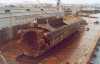 While completing naval exercises with dummy torpedoes on August 12, 2000, the Russian submarine Kursk suffered two explosions two minutes and 15 seconds apart. The second explosion registered about a 3.5 on the Richter scale. The blasts destroyed the front hull, and all 118 crew members died. It was initially believed that the entire crew died quickly. However, what evidence later suggested that some survived in another area of the submarine for about four hours after the explosions?
 While completing naval exercises with dummy torpedoes on August 12, 2000, the Russian submarine Kursk suffered two explosions two minutes and 15 seconds apart. The second explosion registered about a 3.5 on the Richter scale. The blasts destroyed the front hull, and all 118 crew members died. It was initially believed that the entire crew died quickly. However, what evidence later suggested that some survived in another area of the submarine for about four hours after the explosions?
Today’s Birthday
-
James Buchanan "Diamond Jim" Brady (1856)August 12, 2026
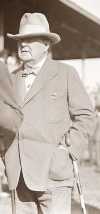 Financier and philanthropist "Diamond Jim" Brady exemplified the American Dream. He started out as a bellboy and messenger before getting a job with the New York Central Railroad and then working his way up through the industry, eventually amassing a fortune selling railroad supplies. With his newfound wealth, he indulged in his two greatest weaknesses: food—one restaurant owner reportedly called him "the best 25 customers I ever had"—and jewels. What was supposedly a typical meal for Brady?
 Financier and philanthropist "Diamond Jim" Brady exemplified the American Dream. He started out as a bellboy and messenger before getting a job with the New York Central Railroad and then working his way up through the industry, eventually amassing a fortune selling railroad supplies. With his newfound wealth, he indulged in his two greatest weaknesses: food—one restaurant owner reportedly called him "the best 25 customers I ever had"—and jewels. What was supposedly a typical meal for Brady?
Today’s Holiday
-
Queen's Birthday (Thailand)August 12, 2026
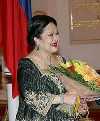 The Queen's Birthday is a nationwide celebration in Thailand of the birthday of Her Majesty Queen Sirikit (b. 1932). Throughout the country, buildings are decorated to honor the queen, but the most splendid are in Bangkok, where buildings and streets are brilliant with colored lights.
 The Queen's Birthday is a nationwide celebration in
 Article of the Day
-
Lake MalawiAugust 12, 2026
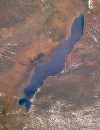 The third largest lake in Africa and ninth largest in the world, Lake Malawi is bounded on the west and south by Malawi, on the east by Mozambique, and on the north by Tanzania. Also known as Lake Nyasa—so named by Scottish missionary David Livingstone in 1859—it is approximately 360 miles (580 km) long with an average width of 25 miles (40 km). Fed by 14 rivers, it is home to more than 200 recorded species of fish—making it one of the most species-diverse lakes in the world. How deep is it?
 The third largest lake in Africa and ninth largest in the world, Lake Malawi is bounded on the west and south by Malawi, on the east by Mozambique, and on the north by Tanzania. Also known as Lake Nyasa—so named by Scottish missionary David Livingstone in 1859—it is approximately 360 miles (580 km) long with an average width of 25 miles (40 km). Fed by 14 rivers, it is home to more than 200 recorded species of fish—making it one of the most species-diverse lakes in the world. How deep is it?
Leave a Reply
You must be logged in to post a comment.